Teen Farm Fellows at Back Beyond Beef
Brock is a junior who is going to Proctor Academy in Andover, New Hampshire. In his free time, he likes skiing, mountain biking, and eating good food.
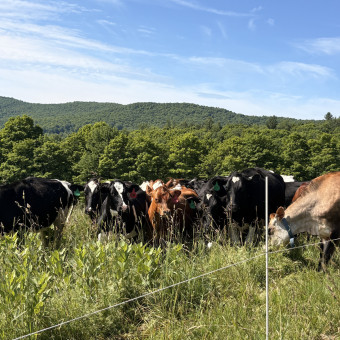
This Wednesday, we went to Back Beyond Beef, owned by Ray Williams, a farm that has collaborated with the Teen Farm Fellows program and Cedar Circle for many years. Ray has around 20 cows grazing in his pastures at any given time, some of which are from other farms that are being boarded at Ray’s. Ray has both female and male cattle; however, the males have been castrated and are therefore friendly and calm around people. Before the pandemic, Ray had around one hundred cows, but now that he is older and now only sells to Cedar Circle, at the farmer’s market, and to some of his neighbors, he keeps a far smaller herd, which means that he doesn’t have to stress over his herd as much. Ray used to raise his own calves but now buys them from another farm.
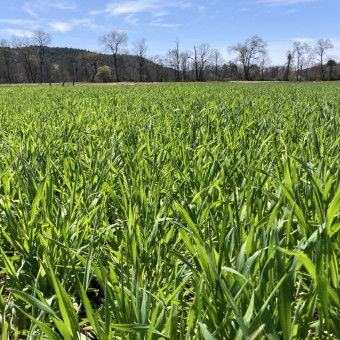
One of the most interesting things that we learned about beef cattle farming is the importance of keeping soil healthy for the grass. Ray does not use any pesticides or herbicides, and so all weeding is either done by the cows, by his brush hog occasionally, or by hand. Rain is slightly acidic, and so, over time, soil will become increasingly acidic. In order to keep the soil healthy and the grass growing, Ray buys lime from a local quarry to put down on his field in order to maintain a balanced pH level in the soil to keep the grass growing. Ray also told us about the nitrogen cycle of the soil and how clover plays an important part in it. Clover is a nitrogen fixer, meaning that it deposits nitrogen into the soil, while grasses and most weeds take nitrogen out of the soil. Once the nitrogen levels in the soil have been depleted, grass struggles to grow, and so the clover takes over and slowly replenishes the nitrogen levels in the soil. Eventually, the more dominant grass will grow in the now nitrogen-rich soil where the clover previously was, and so the cycle repeats.
_1200_773_90.jpg)
We learned a considerable amount about the eating habits of cows and how they consume their food. Cows only have a set of front teeth in their upper jaw and can therefore only bite the top sections of the grass they eat. This turns out not to be an issue for them, however, as it is only the top and middle parts of the grass that they like to eat. This is because while the bottom part of the grass is rich in protein, it is not rich in carbohydrates, which is what the cows are really after. The middle section of the grass is a mix of proteins and carbohydrates, while the top is almost entirely made of carbohydrates. The cows can tell the different parts of the grass apart, along with whether or not they want to eat a certain plant by using receptors on their tongues to gain insight into the composition of any plant they wrap their tongue around. While cows will eat some weeds, there are many that they will not, and they generally prefer grasses or clover. The only issue with eating the clover is that, when eaten in large quantities, can lead to a buildup of gas in a cow’s stomach that can inflate their stomachs, immobilizing them, and in some unfortunate cases, suffocating them.
One of the primary reasons that Ray has a smaller herd this year is that the prices of calves have nearly doubled since last year, from ~$1.75/lb to ~$3.25/lb. Ray explained that this was a regular occurrence due to the classic issues with supply-and-demand economics. These issues being that, when calf prices are cheap, farmers buy many calves, which means that, as beef cattle have a roughly two-year life cycle, farmers will buy fewer calves the next year, lowering demand, meaning that calf-raising farmers will raise fewer calves that year. Then, the year after that, when farmers are looking to buy calves, there is a naturally smaller supply, leading to higher prices for the fewer calves that are on the market.